Skip to content
Briefings are running a touch slower this week while we rebuild the foundations.See roadmap
2026 FIFA World Cup
9JUN

Late injury swaps hit four squads

2 min read
09:45UTC

Netherlands, Brazil and Germany confirmed injury replacements before the deadline, while the USA's Chris Richards returned to training on 8 June.

SportDeveloping
Key takeaway

Netherlands, Brazil and Germany confirmed injury swaps as squads were finalised hours before the registration deadline.

Four nations confirmed late squad changes before the 11 June FIFA deadline. Netherlands lost Jurrien Timber to a groin injury and called up Lutsharel Geertruida. Brazil replaced Wesley, who tore an adductor muscle in a friendly against Egypt on 7 June, with Atalanta midfielder Ederson. Germany swapped the injured Lennart Karl for Assan Ouédraogo of RB Leipzig 1.

The United States, by contrast, gained a player rather than losing one. Defender Chris Richards returned to full training on 8 June after two torn ankle ligaments but had not been confirmed as a starter. His original injury ruling, made before the USA's friendly with Germany, set the 11 June swap context that the whole field was working against .

Unlike Canada, where two slots stayed open into the final hours, these were clean substitutions of one named player for another. The pattern across them is timing: a replacement called up days before the opener arrives with no friendly to play into and a coaching staff that must integrate a new face on the training pitch alone. The expanded 48-team tournament magnifies the volume of these last-minute calls, each settled against the same hard registration cutoff.


Deep Analysis

In plain English

In the final week before the World Cup, four major nations had to swap players out of their squads because of injuries. The Netherlands lost Jurrien Timber, a defender, to a groin problem. Brazil lost Wesley, a forward, after he tore a muscle in his leg during a warm-up friendly against Egypt. Germany lost Lennart Karl, a defender, to a thigh injury. Each team called in a replacement from their extended squad list before the 11 June deadline. For the United States, the situation was less clear: centre-back Chris Richards had been ruled out of the Germany warm-up match in early June with two torn ankle ligaments, but by 8 June he had returned to training. The US had to decide by 11 June whether to keep him in the squad or replace him; his status had not been confirmed as fit when this update was written.

Deep Analysis
Root Causes

All three confirmed injuries occurred during late-season club matches or warm-up friendlies. Wesley's adductor tear happened in Brazil's 7 June Egypt friendly, a game played when the club season in England's Premier League and Italy's Serie A had already finished but Brazil's preparation schedule ran to the edge of the replacement window.

Groin and thigh muscle injuries in this phase of a season reflect accumulated soft-tissue fatigue; players competing at Champions League or Europa League level through May carry load profiles that make a pre-tournament friendly a genuine injury risk, not a safe run-out.

FIFA's replacement rules create a perverse incentive: teams hold injury-risk players in the squad until the last possible moment to avoid showing tactical weakness to opponents. A squad announcement with a fit player who then withdraws protects information for longer than an early replacement, but it compresses the replacement's integration time to near zero.

What could happen next?
  • Consequence

    Assan Ouedraogo joins Germany's squad with minimal tournament preparation time; a player integrating a new tactical system in days rather than weeks carries a higher performance variance in early group matches.

  • Precedent

    Five confirmed injury replacements across four squads in a single week, all soft-tissue, supports FIFPro's data-backed lobbying for a mandatory recovery window between domestic season end and World Cup squad camps.

First Reported In

Update #17 · Host turns back a World Cup referee

ESPN· 9 Jun 2026
Read original
Causes and effects
This Event
Late injury swaps hit four squads
The 48-team field is being finalised in real time, with replacements who get no competitive minutes to integrate before their nations' opening matches.
Different Perspectives
Norwegian Football Federation
NFF president Lise Klaveness sent a letter of support backing FairSquare's Article 15 ethics complaint against Infantino, explicitly noting Norway was acting alone as a deliberate signal. The filing converted an external NGO campaign into the first internal federation action against the FIFA president, arriving in the same fortnight as Platini's Paris criminal complaint.
US Customs and Border Protection
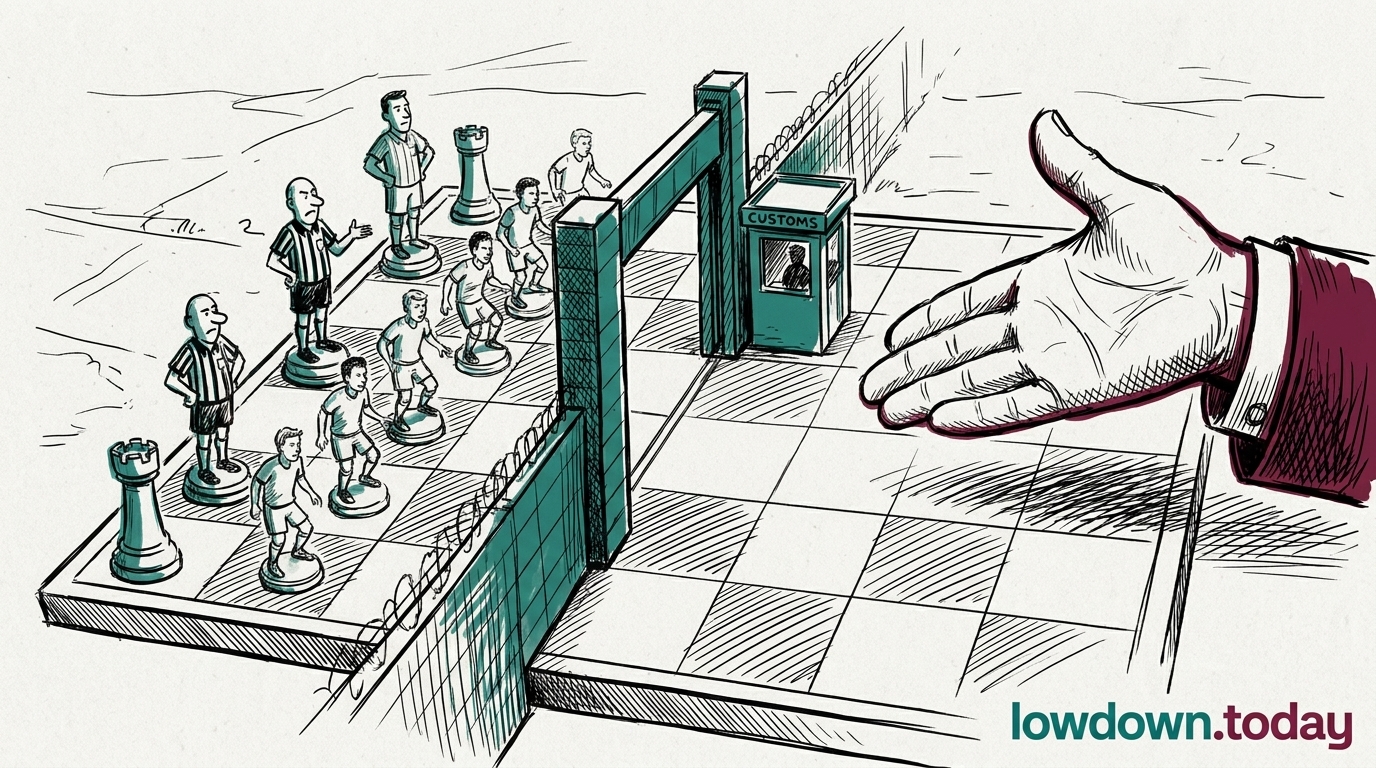
CBP barred FIFA-appointed referee Artan at Miami on 7 June and detained Iraq striker Hussein for seven hours at O'Hare on 8 June, citing vetting concerns in both cases without disclosing specific grounds. Neither a valid visa nor FIFA accreditation constrained the port-of-entry determination under 8 USC 1182.
Canada Soccer
Canada Soccer
Canada reached the 11 June squad lock with two unresolved slots: Flores's ACL rupture confirmed and Bombito's tibia fracture publicly disputed by coach Jesse Marsch against TSN reporting. The co-host's inability to finalise 26 players two days before its own opener against Bosnia underlines the medical attrition compressing the whole pre-tournament window.
FFIRI / Iran
FFIRI / Iran
Iran's federation flew its 26-player squad to Tijuana without visas for 14 support staff, running World Cup preparation by remote coordination across a border rather than withdraw and forfeit $10.5m in prize money. The Tijuana arrangement reflects a calculated decision to participate under degraded conditions while building a post-tournament legal record through a pending Article 4 complaint.
FIFA
FIFA
FIFA invoked its standard host-agreement disclaimer on each access denial, stating it is not involved in host-country immigration processes and that the host government ultimately determines entry. Infantino's 'no Plan B' confirmation on Iran means FIFA has formally accepted the Tijuana split-delegation as the operational baseline, with no contractual remedy in play.
Andrea Abodi / Italian Sports Ministry
Abodi's ANAC referral on Malagò's FIGC eligibility set a 15 June deadline, meaning Italy's federation leadership crisis peaks at the midpoint of the group stage. Malagò holds more than 50 percent of the assembly bloc but cannot take office while the pantouflage cooling-off challenge is formally live.


