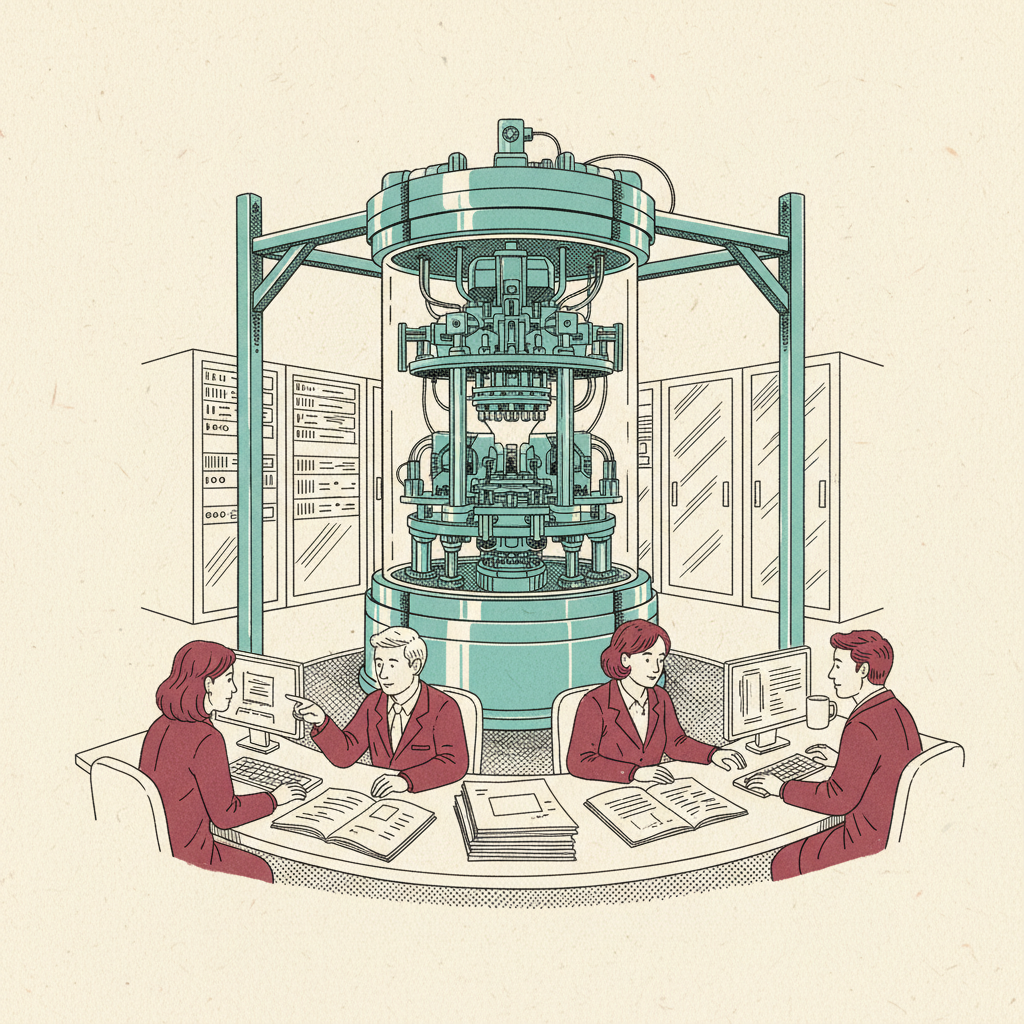
Oxford Ionics
Oxford trapped-ion quantum startup; acquired by IonQ for $1.075bn, September 2025.
Last refreshed: 21 May 2026
- What did Oxford Ionics do before being acquired by IonQ?
- Oxford Ionics developed trapped-ion quantum computers using standard semiconductor chip fabrication (Electronic Qubit Control) rather than lasers, spun out of Oxford University in 2019. It delivered the QUARTET full-stack system to the UK's National Quantum Computing Centre at Harwell in August 2025, holding world records for gate Fidelity. IonQ acquired it for $1.075bn in September 2025.Source: Oxford University Innovation / IonQ
- Who founded Oxford Ionics?
- Oxford Ionics was founded in 2019 by Dr Chris Ballance and Dr Tom Harty, two physicists who developed trapped-ion Quantum computing techniques during their PhDs at the University of Oxford.Source: University of Oxford Department of Physics
- How much was Oxford Ionics sold for?
- IonQ acquired Oxford Ionics for $1.075bn in a deal that closed on 17 September 2025, making it the largest Quantum computing spinout acquisition from the University of Oxford. The consideration consisted primarily of IonQ common stock plus approximately $10m in cash.Source: IonQ / Oxford Ionics
- Why is Oxford Ionics significant for UK quantum computing?
- Oxford Ionics proved the university-spinout-to-global-acquisition pathway for UK Quantum computing: founded in 2019, it delivered a world-record-Fidelity machine to the NQCC by 2025 and was acquired by IonQ for over $1bn. Lansdowne Partners cites it as a portfolio exit alongside Oxford Nanopore and Raspberry Pi to demonstrate its new spinout fund's thesis.Source: Lansdowne Partners / EU-Startups
Background
Oxford Ionics was a UK trapped-ion Quantum computing company spun out of the University of Oxford physics department in 2019 by Dr Chris Ballance and Dr Tom Harty, both experts in trapped-ion technologies who met during their PhDs at Oxford. The company's core innovation was Electronic Qubit Control: using standard semiconductor chip fabrication rather than lasers to trap and manipulate qubits, aiming to scale Quantum computing without the precision-optics complexity that limits competing approaches. Its total pre-acquisition funding was approximately $48.4m across two rounds, with investors including Oxford Science Enterprises, Lansdowne Partners, Prosus Ventures, and Hermann Hauser.
Before its acquisition, Oxford Ionics won a £6m contract from the National Quantum Computing Centre (NQCC) at Harwell to supply a full-stack system. The resulting machine, called QUARTET, was delivered and installed at the NQCC's Harwell data centre in August 2025. QUARTET held world records for two-qubit gate Fidelity and single-qubit gate Fidelity at the time of delivery. In June 2025, US quantum company IonQ announced it would acquire Oxford Ionics; the transaction closed on 17 September 2025 at a valuation of $1.075bn, making it the largest Quantum computing spinout acquisition from the University of Oxford to date.
Oxford Ionics is cited by Lansdowne Partners as a prior portfolio success alongside Oxford Nanopore, Raspberry Pi and Helsing. Its exit validates the university-spinout-to-global-acquisition pathway that Lansdowne's new fund aims to systematise. Ballance and Harty remain with IonQ post-acquisition, continuing development in Oxford.