AI Driver
Wayve's end-to-end neural network AV software; chip-agnostic, learns from human demonstration rather than hard-coded rules.
Last refreshed: 22 April 2026
Why did AMD, Arm and Qualcomm all back the same autonomous-driving software in one round?
Timeline for AI Driver
Mentioned in: Wayve lands $60m from AMD, Arm and Qualcomm
UK Startups and InnovationBackground
AI Driver is the product at the centre of Wayve's April 2026 fundraise: a $60m Series D extension from AMD, Arm and Qualcomm, the three chip architectures that also form the silicon spine of Nscale's $2bn compute build-out. The fact that three competing chip vendors backed the same AV software company signals AI Driver's chip-agnostic design as commercially significant — none of the three investors is buying vendor lock-in. DSIT staged the Sovereign AI Unit launch at Wayve's London HQ the day after the round closed.
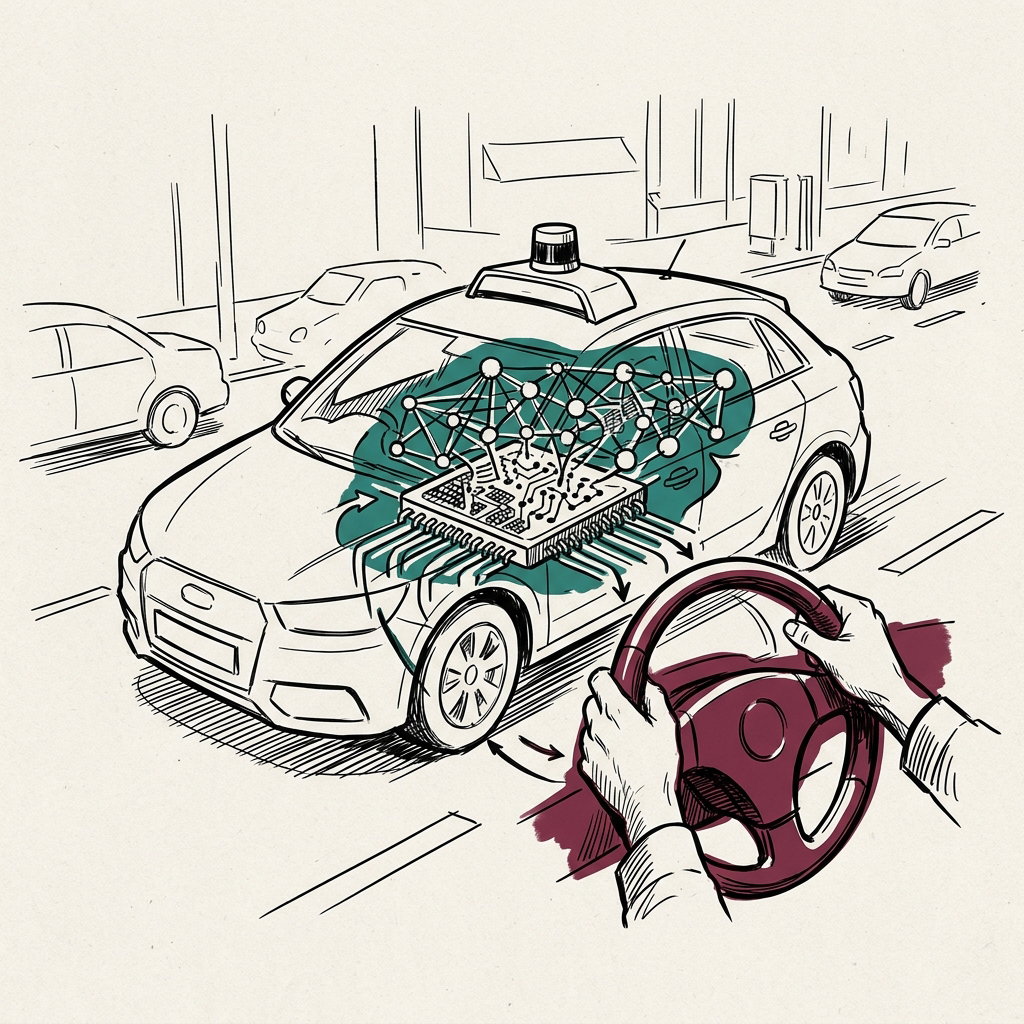
AI Driver is an end-to-end neural network that learns to drive by observing human driving demonstrations, rather than by following hand-coded rules for every traffic scenario. The model ingests sensor data (camera, lidar, radar), infers the correct action, and outputs vehicle controls directly — no separate perception, prediction and planning modules. Because the network is trained on behaviour rather than rules, it generalises to new cities, weather conditions and road types without per-location engineering. Its chip-agnostic architecture means the same trained model can run on AMD, Arm and Qualcomm silicon without retraining.
The contrast with rule-based AV stacks (Waymo, Cruise) is the strategic stake. Rule-based systems require explicit geographic mapping and scenario scripting; AI Driver's learned representations do not. That makes deployment economics fundamentally different: the marginal cost of entering a new city is a fine-tuning run rather than a mapping expedition. For the chip vendors that backed Wayve, AI Driver also represents a software layer that validates their silicon's fitness for autonomous driving without committing to a single hardware vendor — a hedge on the sovereign AV stack question that the UK government is quietly watching.